Wednesday, March 31, 2010

Editing using Photoshop

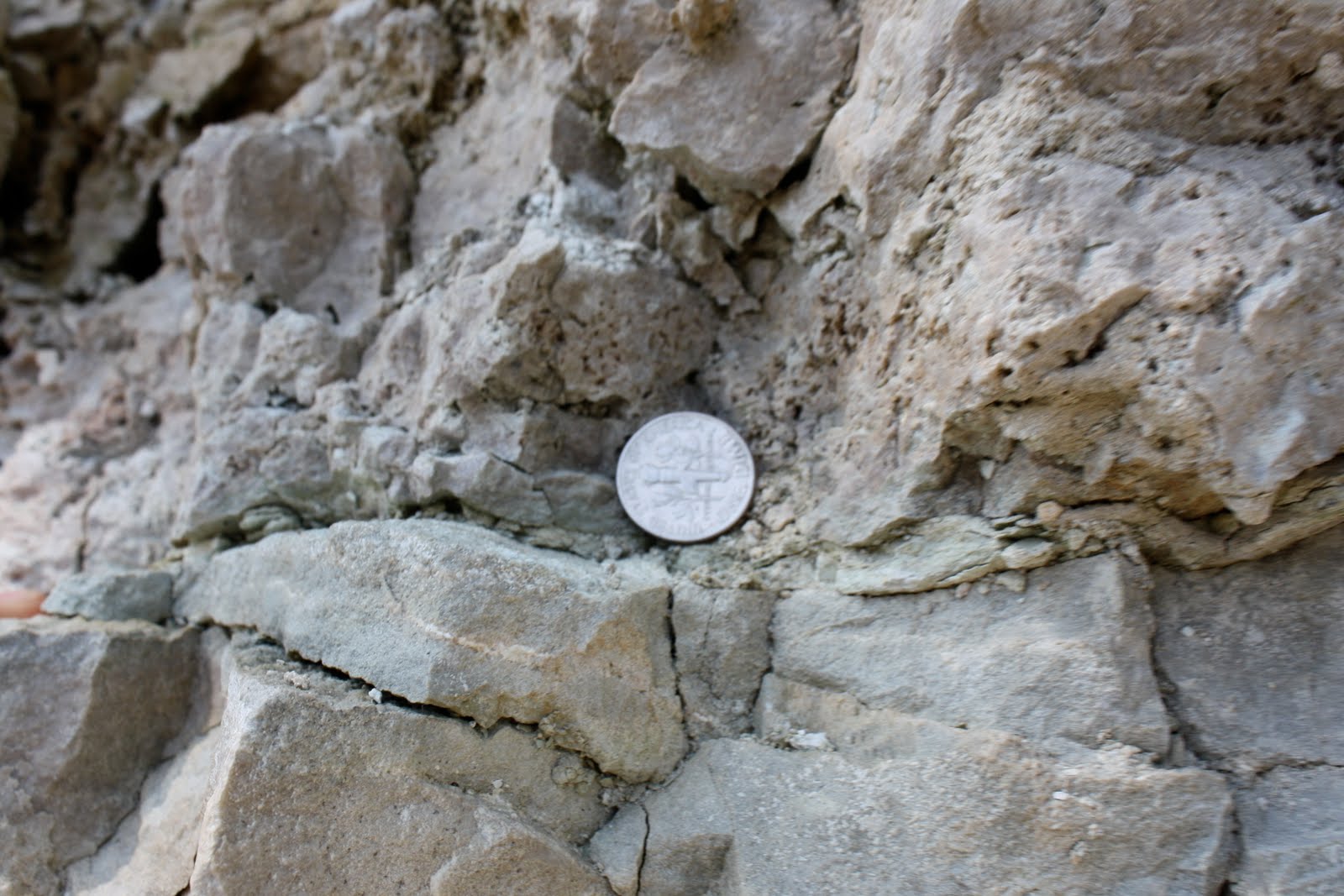
Here is a coarse crystalline dolostone that was taken in the field at the Westphalia outcrop. If you want to get an idea where it is in the outcrop, it is found approximately between 13 and 15 meters on the stratigraphic column that I posted previously.


Here is the photoshoped version of that dolostone to show the vuggy and fenestral porosity


Strat Column from Illustrator

Here is the stratigraphic column of the Westphalia outcrop that me & Dr. Parcell measured in Missouri. It contains the Roubidoux, Gasconade, and Jefferson City/Cotter Dolomite formation of the Arbuckle Group in the Early Ordovician Period.

It contains mostly fine to coarse crystalline cherty dolomite with some sandstone beds. There are some stromatolites and thrombolites(???) in a few of these beds.

I have not made the legend as yet, but I will be put it up later. There is 50+m of thickness so it looks a little blurry.


Wednesday, March 3, 2010

Cores du microbes

I am on a GeoMapApp mission to find microbial traces in the sea floor sediment cores available in this database. If not in this database, then I will try looking in other databases as well.
Initially I will just be looking for traces to see if there is even any data available in this area.
If I find anything, I would like to figure out their ages which hopefully the cores will contain. Then try to infer depositional environments using other data available in the cores and finally have a comparison to the Ordovician microbialites that I am researching on.
If such data is quite recent, then I can use it as an analogue for comparison.

So far data that I have found in some of the cores contain mottling but there is no indication of bacterial or algae activity; so far no evidence of microbial laminations either. I will continue to explore the database and if nothing turns up I will have to look for another project.

So if anyone has any food for thought about this project, let me know.

Monday, March 1, 2010

Thursday, February 11, 2010

References

1)Brunton, F. R., and O. A. Dixon (1994), Siliceous Sponge-Microbe Biotic Associations and Their Recurrence through the Phanerozoic as Reef Mound Constructors, Palaios, 9(4), 370-387.

Environmental indicator of the Early Ordovician (and other Phanerozoic periods) by buildup of siliceous sponge-microbe reef mounds. The article talks about the common attributes of the reef mounds which include the abundance of thrombolites, but fewer stromatolites during the Phanerozoic episodes of reef mound construction. I will mostly refer to the Ordovician microbialites mentioned in this article

2)Burne, R. V., and L. S. Moore (1987), Microbialites: Organosedimentary Deposits of Benthic Microbial Communities, Palaios, 2(3), 241-254.


3)Davis, R. A. (1966), Willow River Dolomite - Ordovician analogue of modern algal stromatolite environments, J. Geol., 74(6), 908-923.


Descriptions of algal stromatolites found in the Shakopee Formation (in particular the Willow River Dolomite member) of the Lower Ordovician of the Upper Mississippi Valley are found to have been deposited in an environment similar to that of modern intertidal carbonate depositional environments of Florida and Australia. Similar depositional environments in which the Willow River dolomite was formed is found in the Appalachian, Ozark, and central Texas areas during the Lower Ordovician.


4)Dill, R. F., E. A. Shinn, A. T. Jones, K. Kelly, and R. P. Steinen (1986), Giant subtidal stromatolites forming in normal salinity waters, Nature, 324(6092), 55-58.

5)Druschke, P. A., G. Q. Jiang, T. B. Anderson, and A. D. Hanson (2009), Stromatolites in the Late Ordovician Eureka Quartzite: implications for microbial growth and preservation in siliciclastic settings, Sedimentology, 56(5), 1275-1291.


Siliciclastic domal stromatolites found in the Later Ordovician Eureka Quartzite of Southern Nevada and Eastern California give some insight into the growth of microbialites in siliciclastic environments - I have blogged about this called Environment vs. Microbialites.

6)Ginsburg, R. N. (1967), Stromatolites, Science, 157(3786), 339-340.


A compilation of brief descriptions of how stromatolites are theorized to form by different geologists' perspective and how they are environmental indicators. This article is from a presentation on a historical review of stromatolites.


7)Kennard, J. M., and N. P. James (1986), Thrombolites and Stromatolites: Two Distinct Types of Microbial Structures, Palaios, 1(5), 492-503.


8)Logan, B. W., R. Rezak, and R. N. Ginsburg (1964), Classification and Environmental Significance of Algal Stromatolites,
The Journal of Geology, 72(1), 68-83.


This authors of this article has come up with a method of classification of stromatolites based on their geometric shapes and how their shapes, sea-level, and the environment affect their growth.


9)
Overstreet, R. B., F. E. Oboh-Ikuenobe, and J. M. Gregg (2003), Sequence stratigraphy and depositional facies of Lower Ordovician cyclic carbonate rocks, southern Missouri, USA, J Sediment Res, 73(3), 421-433.

10)Shinn, E. A. (1991), Tidal Flat Environment in Carbonate Depositional Environments (Eds P.A. Scholle, D.G. Bebout, and C.H. Moore), AAPG Mem., 33, 171-210.

Monday, February 8, 2010

Environment vs. Microbial Colonization

Siliciclastic environment stromatolites are not as common in the rock record as carbonate environment stromatolites.

A study done on stromatolites during the Late Ordovician indicates a few reasons for the lack of preservation of stromatolites (and maybe other microbialites) in siliciclastic environments.

Early cementation and lithification are processes necessary for the preservation and growth of stromatolites. Siliciclastic environments may require carbonate alkalinity that is much more than in a carbonate environment to produce this early lithification & cementation as the carbonate cements may get replaced by silica during diagenesis.

Successful colonization in siliciclastic environments also require that the sandy substrate is not mobile (which is generally high in these environments) as stabilization of the sediment is required for the bacteria to produce these microbial layers. This is true in carbonate environments too.

The presence of translucent quartz grains present in these environments will also help these colonies as they allow the necessary amount of sunlight required for photosynthesis.

These and other reasons can be found in the article by Druschke, Jiang, Anderson, and Hanson called Stromatolites in the Late Ordovician Eureka Quartzite: implications for microbial growth and preservation in siliciclastic settings in Sedimentology (2009).

Thus, here is a case which is a reminder that microbialites are not just present in carbonate environments and the presence of burrows found along with the stromatolites in this study also indicates that burrowing organisms are not a limitation for the growth of these microbialites which initially I thought may be restricting the microbialites to more saline waters.


Burrowed stromatolites (adapted from Druschke et. al, 2009)
Sunday, February 7, 2010

Stromatolite or Pisolite?

I came across this site which is a virtual fossil museum and was curious to see if they had any microbial specimens. They did and interestingly enough there were some pictures of these stromatolites found during the Lower Cambrian that looked like pisolites. I must not be thoroughly exposed to all types of stromatolites since some of these pictures confused me. But I guess that is the nature of nature. It is complicated. What seems to be a pisolite is in fact a stromatolite. But who's to say that you cannot call it a pisolite too? It's spherical, has a nucleus and cortices, and is wider than a mm. So the only difference is that bacterial matter created the cortices around the nucleus instead of by mechanical/physical processes. That is, if this is actually a stromatolite.

So here's the link to that picture: http://www.fossilmuseum.net/Fossil_Galleries/Stromatolites/Stromatolite461/DS461g.jpg

Here's the link to the website: http://www.fossilmuseum.net/Fossil_Galleries/StromatolitesAmerica2.htm

There are some other questionable stromatolite pictures in this website. I am not sure about the credibility of the website or I maybe ignorant!