Friday, July 15, 2011

Different types of grounds

So I started taking a closer look at how a transgressive lag would be identified. A transgressive lag (Fig. 1) is a deposit that you find at the base of a sequence of rocks that occur from the rise of the sea level or as the shoreline moves landwards.

Transgressive lags are associated with ravinement surfaces. A ravinement surface (Fig. 1, 4) is the surface that gets scoured off as the "front" of the sea makes it's way landwards.
Fig. 1 shows a general idea of how a transgressive lag with a ravinement surface is formed.


Fig. 1
Regression is the opposite of transgression, when the sea level drops or the shoreline moves towards the sea.
You can find this picture in the SEPM website


At this ravinement surface, certain types of ichnofacies (eg. Glossifungites in Fig. 1, 4) or rocks that contain traces left behind by organisms (eg. as they burrow) can be found. The type of ichnofacies (which in turn depends on the type of organism creating the trace fossil or ichnofossil) depends on the different types of grounds.

So let's look at 4 types of grounds:
1) Softground
2) Firmground
3) Hardground
4) Woodground

All these grounds are exactly as the word says.

1) A softground is loose material that is wet and has not been compacted and consolidated into rock yet. For eg. the top layer of a beach (Fig. 2, 3). Many different ichnofacies can occur here. Refer to the picture here to get an idea. A softground is probably not going to show up in a ravinement surface or any other geological record because it is easily eroded away.


Fig. 2
Softground. Beach sand forming dunes (that will turn into cross bedding if it gets compacted and preserved) with organic material (dark layers in the top right) from the lagoon behind.
Northeast Trincomalee, Sri Lanka 2009.


2) A firmground is loose material that has been compacted and most of the water been removed by the compaction from the sediment at the top. Fig. 3, 4.

Fig. 3
Softground is found at the top and firmground a little below the surface. The black layers are organic material. Of course since this picture is showing the layers being eroded away by the water, you don't see the firmground being very firm!
Note the possible cross bedding being formed at the bottom of the pic where the water is. This is a little behind in location from Fig. 1.
Northeast Trincomalee, Sri Lanka 2009.


Fig. 4
Glossifungites ichnofacies on firmground from the Pleistocene (2.6my to 11,000y). These trace fossils have been made by mud shrimp (Upogebia pugettensis).The softground has been eroded away. This surface would be a ravinement surface.
Goose Point at Willapa Bay, WA. Photo by M. K. Gingras from Catuneanu, 2006, p. 38.


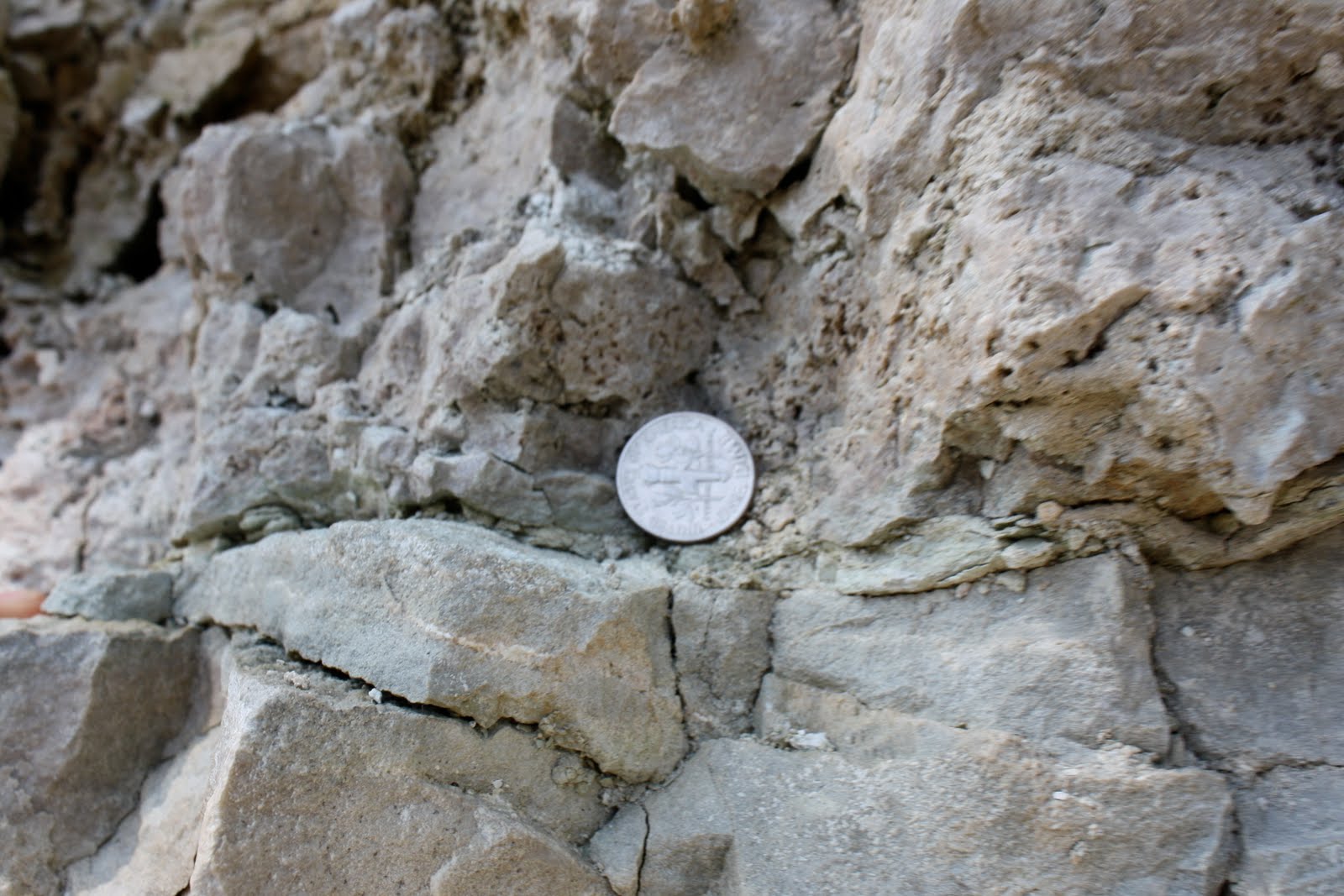
3) A hardground is material (mostly those that trickle down onto the ocean floor) that has been compacted, de-watered, and cemented into rock and can usually be found at the bottom of a column of water like the ocean floor where the water has been above the sediment for a while. You can find more on hardgrounds here.


Fig. 5
Hardground formed during the Middle to Late Ordovician (472-444my) in an open marine environment. Bivalve fossils present.
This picture does not however show a ravinement surface.
Viola Limestone in the Arbuckle Mountains, OK, 2008.


4) A woodground is separate from the soft-firm-hard-ground trio. It is material that is formed from the compaction of xylic (wood) material. These can usually be found where wooden material such as logs break down and compact or where compacted peat occur. These woodgrounds can contain ichnofossils called Teredolites thought to be created by certain bivalves. I don't have any clear pictures of this and none i can find on the internet either. Maybe if someone has one, they can contribute it? Here's the reference to woodgrounds. Unfortunately i don't have access to that paper, so if you do, do check it out and tell me about it. :D

Update I recently came across on Woodgrounds & Teredolites can be found here on a recent post by Eric from The Dynamic Earth.

There is a 5th type of ground called Soupground where the material is just slurry and constantly wet. But I would probably just put that in with softground as it is probably not going to show up in the geologic record! But it can most definitely be used as a descriptor for present times. So it should not be totally overlooked.

You'll find some of the ichnofacies terms i have mentioned here. And here's a blog on a trace fossil on a hardground (during Middle Jurassic - 176 to 160my) in Israel by the Wooster geologists. They are HUGE!

If anyone has other pics to contribute of these different types of grounds, please do so! :D


References:
1) Posamentier, Henry W., and George P. Allen, 1999, Siliciclastic Sequence Stratigraphy - Concepts and Applications, Society of Economic Petrologists and Paleontologists, p. 216.

2) Catuneanu, O, 2006, Methods of Sequence Stratigraphy Analysis. In Principals of Sequence Stratigraphy, Elsevier, p. 375.

Saturday, July 9, 2011

Fanglomerates - deceptive but not if you take a closer look

The new word I learned today is Fanglomerate. I think it's quite strange where I came across it. I'm currently reading a book about stromatolites (since after all my thesis work is about them), and one of the chapter's is explaining the physicochemobiogeo (hope that's a word! should i add nano?? ;D) changes that had occurred to the 3rd rock from the sun that caused the right environment for these organo-sedimentary structures to form. Suddenly the author decides to throw out the word fanglomerates as part of continental deposits created around 2.6-2.0 by. So ofcourse my 1st reaction is that it's a conglomerate.....but why term fanglomerate? So unlike flakestone, there's plenty of descriptions and definitions about fanglomerates. Made me feel stupid of course! Didn't see the break down of the word to fanglomerate.....

So to sum up what i've read about fanglomerates: these are conglomerates (my gut instinct has never failed me!) but those that are usually coalesced to form an alluvial fan. Thus they would mostly be found at mountain foothills where the mostly coarse (large) material eroded off the mountains mixed with finer material to form the fan at it's base or into a mountain lake and then was cemented and solidified into a rock.

Here's the American Geologica Institute definition:
http://glossary.agiweb.org/dbtw-wpd/exec/dbtwpub.dll

So my question is, can a delta or deep water alluvial fan be called a fanglomerate too?

And I have to give credit to a geologist Callan Bentley where he has a good picture of a fanglomerate that is found at a contact metamorphism near the Sierra Nevadas! Check out his blog & pictures:
http://mountainbeltway.wordpress.com/2010/04/02/baked-fanglomerate/

Now i understand why my professor goes off on a tangent every time she lectures! I went off on the biggest tangent yet enough to blog, whilst reading about stromatolites! :( Back to work!

Wednesday, June 29, 2011

Flakestones - a self-explanatory word

I ran into the word flakestone as I was doing some reading on the Trucial Coast tidal flats. And even though the word is pretty self explanatory I wanted to find out what it actually meant and how it could form. So as usual I checked the internet's most reliable for definitions - google, Schlumberger's oilfield glossary, geology.com and about.com. Not getting anywhere, I decided to do some research and this is what I have come up with.

As the name suggests, these are rocks made from flakes and may have different compositions. They may be of dolostones/dolomites (flake-breccias) origin (Fairchild, 1980) or
they may be of mudstone (mud-flake breccias) origin (Fairchild, 1980, Pickering, 2005).

I have so far, mostly come up with them being formed in marine settings; be it shallow or deep, but that maybe because I am biased towards reading more about marine carbonates.

In the shallow marine, these flakes are usually related to dessication cracks where after forming the cracks these flakes can be found within those cracks that are more susceptible to erosion as they get transported to those 'depressions'. (See figure below)

Another creation of the flakes may be due to sliding or slumping of the material as found in the more deeper marine settings. And whence formed into a rock, it's called a flakestone.


Flakestone portion as part of a flake pocket of dolostone flakes (Adapted from Fairchild, 1980)


My initial idea was that these flakestones were similar to conglomerates. In a manner, they are a type of breccia more than conglomerate since they may form due to slides and slumps and are more pointy at both the edges.

I hope one day that I will come across a flakestone and thus be no longer confused!


References

Fairchild, I. J., 1980. Sedimentation and origin of a Late Precambrian 'Dolomite' from Scotland. Journal of Sedimentary Petrology, v. 50, n. 2, p. 0423-0446.

Pickering, K. T., Corregidor, J., 2005. Mass-Transport Complexes (MTCs) and Tectonic Control on Basin-Floor Submarine Fans, Middle Eocene, South Spanish Pyrenees. Journal of Sedimentary Research, v. 75, n. 5, p. 761-783.

Thursday, April 15, 2010

Commentry on Flock of Dodos

The movie portrayed how the scientific community has a hard time in portraying their point of view to the general public and how it was easy for the Intelligent Designers to portray theirs.
Even though the producer was part of the scientific community, he was unbiased in portraying how the Intelligent Designers were able to clearly term their reasoning in simple words to the public. This of course makes the public understand and listen to them more. When the scientific community uses their scientific jargon, it is hard for the general public to understand.
The Intelligent Designers were definitely intelligent enough to come up with slogans that caught the eye of the public and were easy to say out loud. I think that is good strategy on their part, and the scientific community should definitely adapt that and instill it in the public school system to get students more interested in science.
Even though, they clearly identified their cause, the Intelligent Design in my opinion is another form of religion and religious views are usually easily adapted by public people since it explains something one cannot understand. Whereas, science still has a lot to prove. But you cannot have science if people are not interested in learning it and keep it moving forward to explain the unexplainable in a logical manner. Thus the scientific community clearly needs to portray that in simpler terms to the general public.

Wednesday, March 31, 2010

Editing using Photoshop

Here is a coarse crystalline dolostone that was taken in the field at the Westphalia outcrop. If you want to get an idea where it is in the outcrop, it is found approximately between 13 and 15 meters on the stratigraphic column that I posted previously.


Here is the photoshoped version of that dolostone to show the vuggy and fenestral porosity


Strat Column from Illustrator

Here is the stratigraphic column of the Westphalia outcrop that me & Dr. Parcell measured in Missouri. It contains the Roubidoux, Gasconade, and Jefferson City/Cotter Dolomite formation of the Arbuckle Group in the Early Ordovician Period.

It contains mostly fine to coarse crystalline cherty dolomite with some sandstone beds. There are some stromatolites and thrombolites(???) in a few of these beds.

I have not made the legend as yet, but I will be put it up later. There is 50+m of thickness so it looks a little blurry.


Wednesday, March 3, 2010

Cores du microbes

I am on a GeoMapApp mission to find microbial traces in the sea floor sediment cores available in this database. If not in this database, then I will try looking in other databases as well.
Initially I will just be looking for traces to see if there is even any data available in this area.
If I find anything, I would like to figure out their ages which hopefully the cores will contain. Then try to infer depositional environments using other data available in the cores and finally have a comparison to the Ordovician microbialites that I am researching on.
If such data is quite recent, then I can use it as an analogue for comparison.

So far data that I have found in some of the cores contain mottling but there is no indication of bacterial or algae activity; so far no evidence of microbial laminations either. I will continue to explore the database and if nothing turns up I will have to look for another project.

So if anyone has any food for thought about this project, let me know.